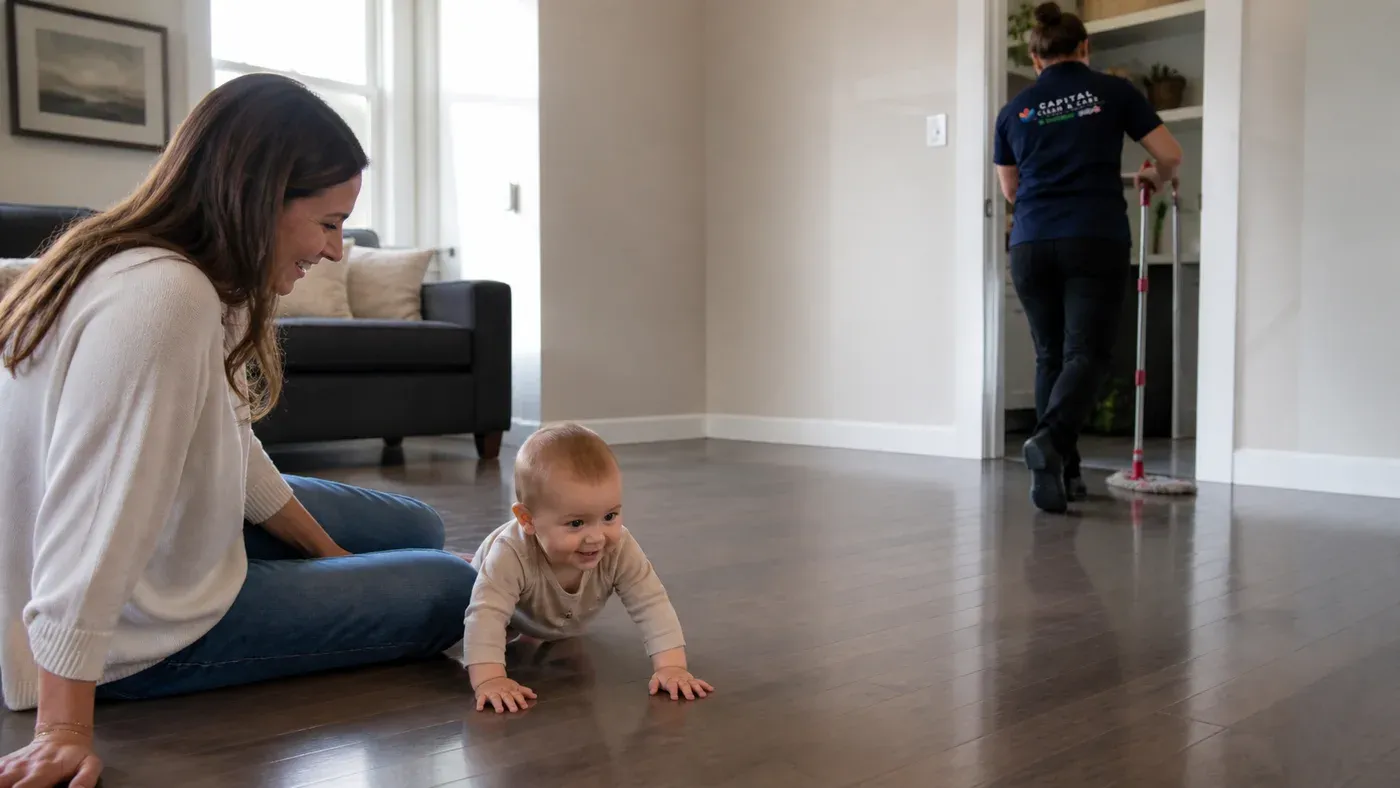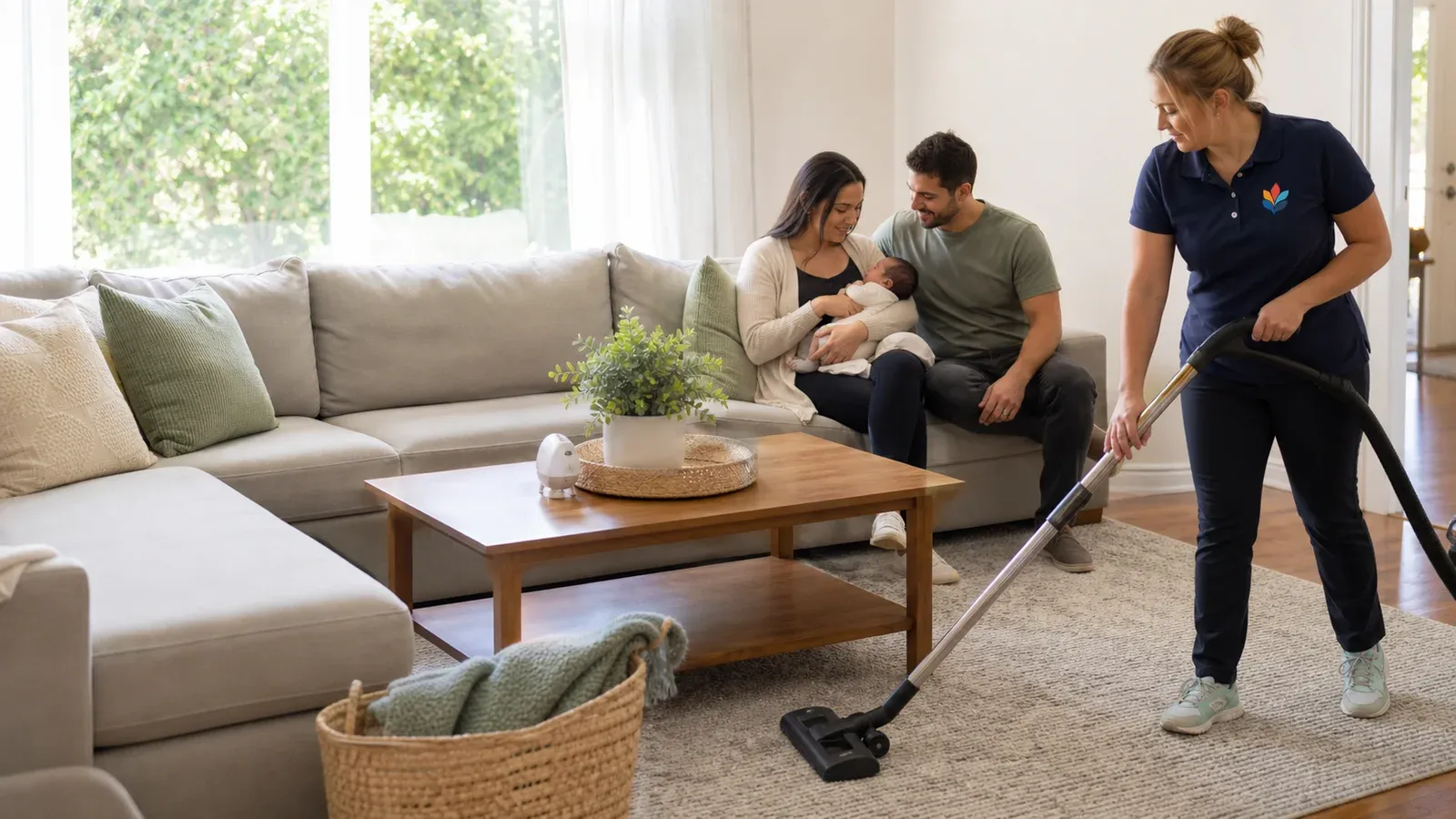
Quick answer: With a newborn, you don't need a sterile house—just a short daily reset. Prioritize feeding items, the changing area, essential laundry, trash, and safe walking paths. Clean visible mess as it happens, disinfect only when a surface is contaminated or someone is sick, and delegate the heavy work so you can rest and recover.
Bringing baby home changes the cleaning priorities. The goal is no longer to finish a pre-baby project list. It is to keep the household functional while feeding the baby, changing diapers, managing laundry, resting, and adjusting to a completely new routine.
Cleaning with a newborn does not require a spotless or completely sterile home. The American Academy of Pediatrics notes that thorough cleaning and common sense—not sterilizing the whole house—are what a new baby needs, and that strong products or heavy sprays can leave odors and residue. A better plan is to protect the spaces and supplies your family uses most, complete a short daily reset, and let lower-priority work wait.
This guide provides a realistic cleaning routine for the first weeks with a newborn, including feeding-item cleanup, diaper-area care, laundry, floors, pets, visitors, and physically demanding tasks that may be easier to delegate. It offers general household information—not medical advice. Ask your pediatrician or healthcare provider about your baby's individual health needs.
What Changes After the Baby Comes Home?
Before delivery, cleaning may revolve around preparation: organizing the sleep area, deep cleaning the kitchen and bathroom, washing baby clothes, and clearing clutter. After the baby comes home, the focus shifts to repetition.
The same few tasks return throughout the day:
- Feeding items need attention after use.
- Diaper and changing areas need a quick reset.
- Laundry accumulates in smaller but more frequent loads.
- Kitchen and bathroom surfaces get used continuously.
- Floors collect crumbs, dust, and pet hair.
- Trash and diaper waste need to leave the house regularly.
Instead of trying to "finish" the house, build a routine that can be paused and restarted. A ten-minute reset completed most days is often more useful than an ambitious cleaning plan that exhausts the household.
What needs attention first—and what can wait
In the first weeks, a short list genuinely needs regular attention: feeding items after each use, the changing area, essential laundry, trash and diaper waste, visible spills, and a clear, safe path through the rooms you use most. These protect daily function and keep a small mess from turning into a bigger one.
Almost everything else can wait. Decorative tidying, organizing closets, washing windows, cleaning low-use rooms, and most deep-cleaning projects are not urgent while you recover. Routine cleaning is usually enough; whole-house disinfecting is not required unless someone is sick or a surface is contaminated. Giving yourself permission to postpone optional work is part of the plan, not a failure.
If you are still preparing for delivery, begin with our Cleaning During Pregnancy guide. This article picks up after the baby is already home.
The Minimum-Viable Daily Reset
The minimum-viable reset is the smallest routine that keeps tomorrow from becoming harder. It is not a whole-house clean.
Choose three to five tasks that can usually be completed in about 10 to 15 minutes:
- Put used feeding items in their designated cleaning area.
- Wipe a visibly dirty kitchen or changing surface.
- Gather essential laundry in one hamper.
- Remove diaper waste and household trash when needed.
- Clear one safe walking path through the main living area.
If the baby needs attention halfway through, stop. The routine is designed to be interrupted.
Try the one-room rule
On difficult days, choose one room instead of the entire house. Reset the kitchen today, the bathroom tomorrow, and the primary living space another day. Bedrooms and low-use areas can wait unless something is visibly dirty or creates a safety concern.
Keep supplies where the work happens
A small, secured set of supplies near the kitchen or bathroom can reduce unnecessary trips through the house. Keep all cleaning products closed, labeled, and inaccessible to children and pets. Do not store them with feeding supplies, food, medication, or baby-care products.
Feeding Items and Pump Parts: Keep This Routine Separate
Baby bottles, nipples, rings, caps, pump parts, and other feeding supplies are not ordinary dishes. Follow the item manufacturer's directions and current guidance from your pediatrician or public-health authorities.
The CDC advises keeping bottle-feeding supplies clean and provides detailed instructions for cleaning, sanitizing, and storing infant feeding items.
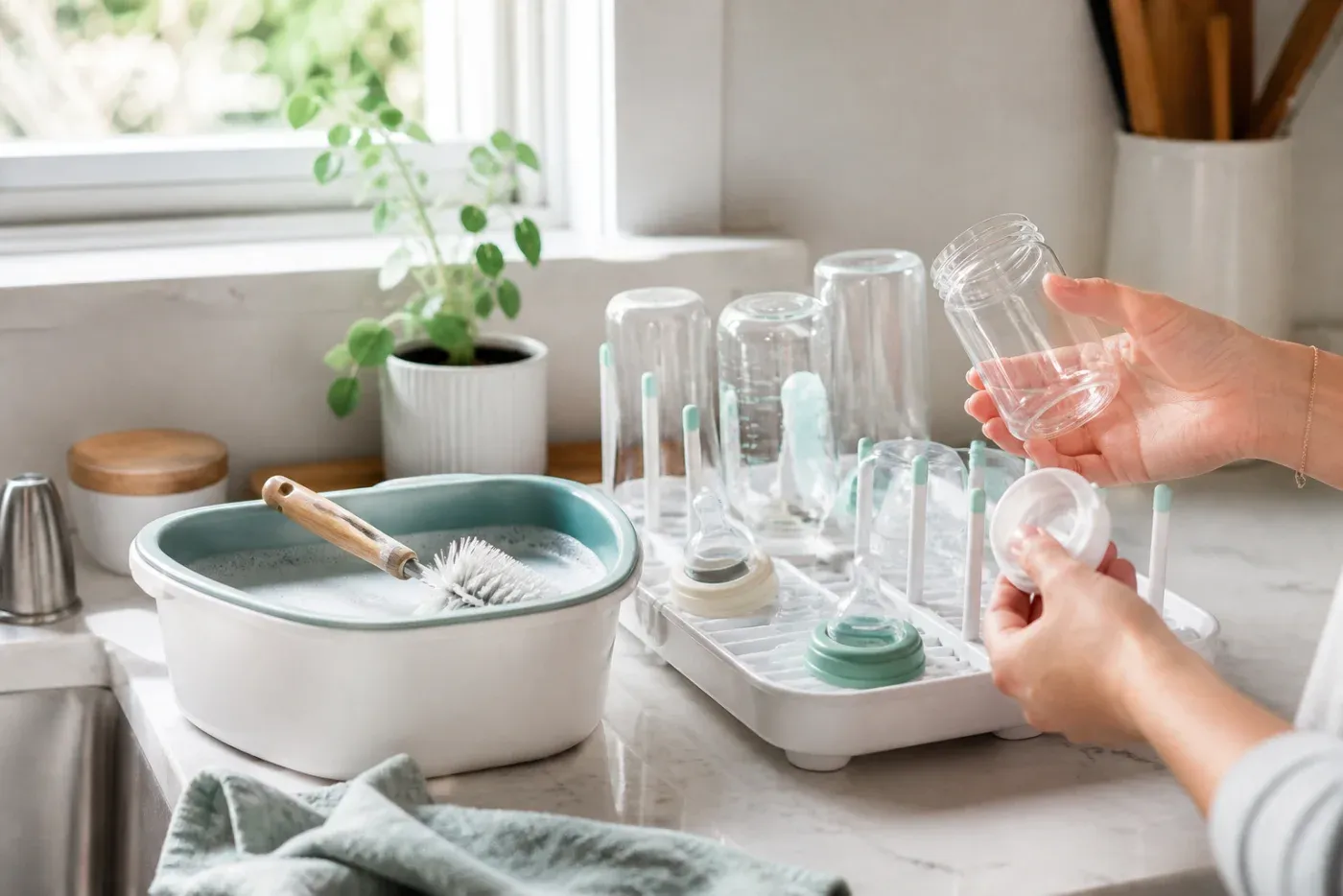
For a practical household setup:
- Create one clearly defined area for used feeding items.
- Wash your hands before handling cleaned or sanitized parts.
- Take bottles and other items apart as directed before cleaning.
- Use the dishwasher only when the manufacturer says the item is dishwasher-safe.
- Allow cleaned items to air-dry thoroughly in a protected area.
- Do not use the feeding-item basin or brush for unrelated household cleaning.
- Inspect nipples, valves, membranes, and other parts for damage or wear.
Sanitizing recommendations can depend on the baby's age, whether the baby was born prematurely, and individual health circumstances. The CDC notes that daily sanitizing is particularly important for some infants, including babies younger than two months, those born prematurely, or those with weakened immune systems. Follow current CDC instructions and ask your pediatrician what is appropriate for your baby.
Keep diaper cleanup away from feeding supplies
Separate diapering and feeding workflows. Do not clean bottles, pump parts, or feeding tools near the changing area. Wash hands after diaper changes and before preparing or handling feeding items.
A Practical Diaper-Area Reset
The changing area should be easy to restore without turning every diaper change into a deep-cleaning project.
After a routine change:
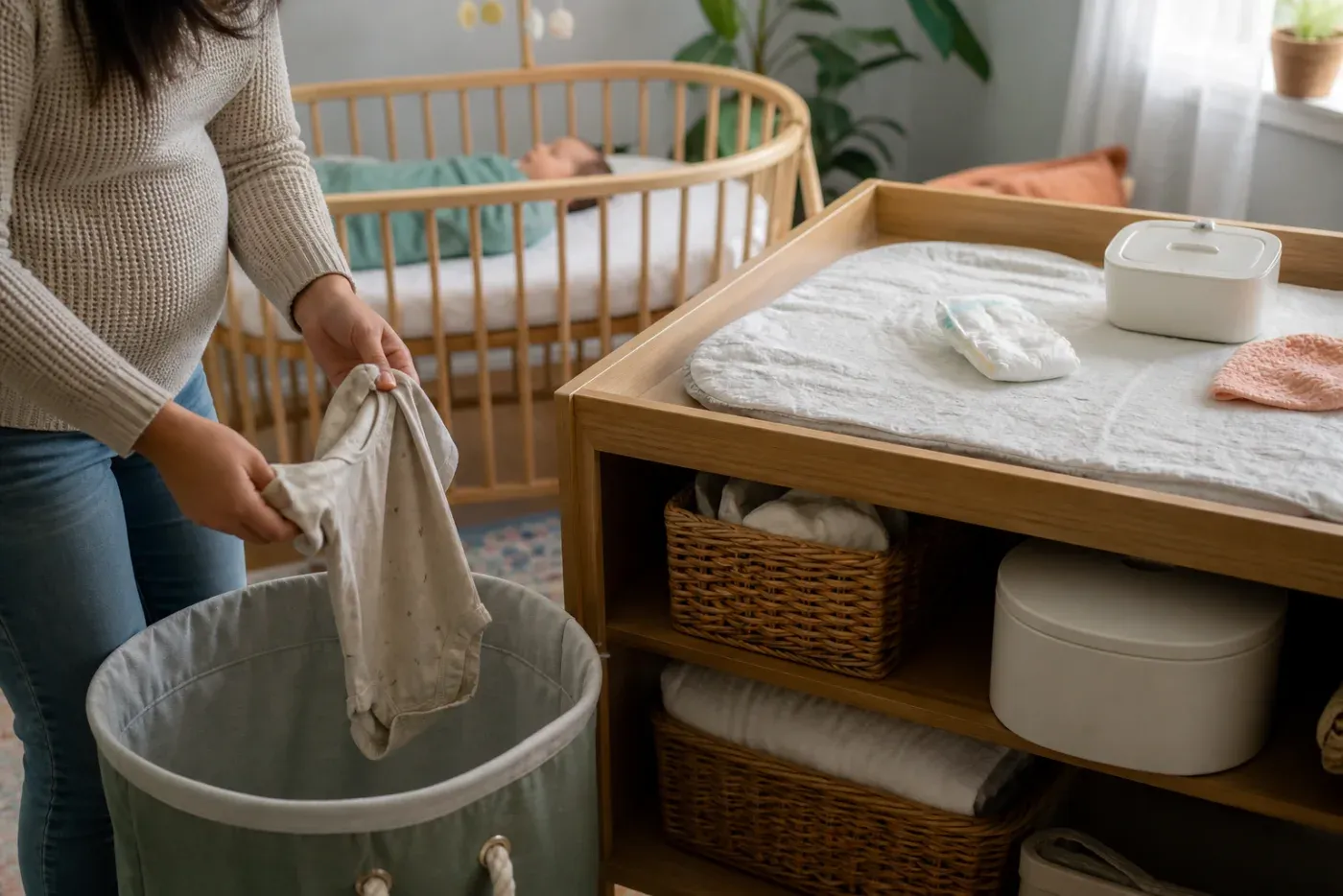
- Dispose of the diaper and wipes appropriately.
- Place soiled clothing or washable covers in a designated hamper or container.
- Clean visible soil from the changing surface according to its care instructions.
- Restock only the supplies needed for the next few changes.
- Wash your hands when finished.
Follow the changing-pad manufacturer's directions before using any cleaner or disinfectant. Some materials can be damaged by products that are too strong or left wet for too long.
If bodily fluids contaminate a surface, clean the visible material first, then follow the product and surface instructions for any additional sanitizing or disinfecting step. Keep the baby away from wet surfaces and cleaning products.
Laundry Without Letting It Take Over the Day
Newborn laundry can feel endless because it includes small clothes, burp cloths, sheets, towels, adult clothing, and occasional heavily soiled items. The answer is usually a simpler sorting system, not larger piles.
Try three categories:
- Needed soon: feeding cloths, essential baby clothes, adult basics, and the linens used daily.
- Can wait: decorative blankets, backup clothing, and nonessential linens.
- Special handling: items that need stain treatment or manufacturer-specific care.
Wash items according to their labels and dry them completely. The CDC's household-cleaning guidance recommends using detergent and the recommended water temperature for laundry.
You do not need to fold every item immediately. A clean basket for frequently used baby clothes and cloths may be more realistic during the first weeks. The objective is to keep clean and dirty items separate and make essentials easy to find.
Floors, Pets, and the Rooms You Actually Use
Your newborn may not be crawling yet, but floors still affect daily comfort—especially when adults are walking through the house, sitting on rugs, or caring for pets.
When your baby does start crawling, floors become an even bigger priority. See our floor-cleaning guide for the crawling stage for how often to mop by floor type and how to choose a safer cleaner.
Prioritize:
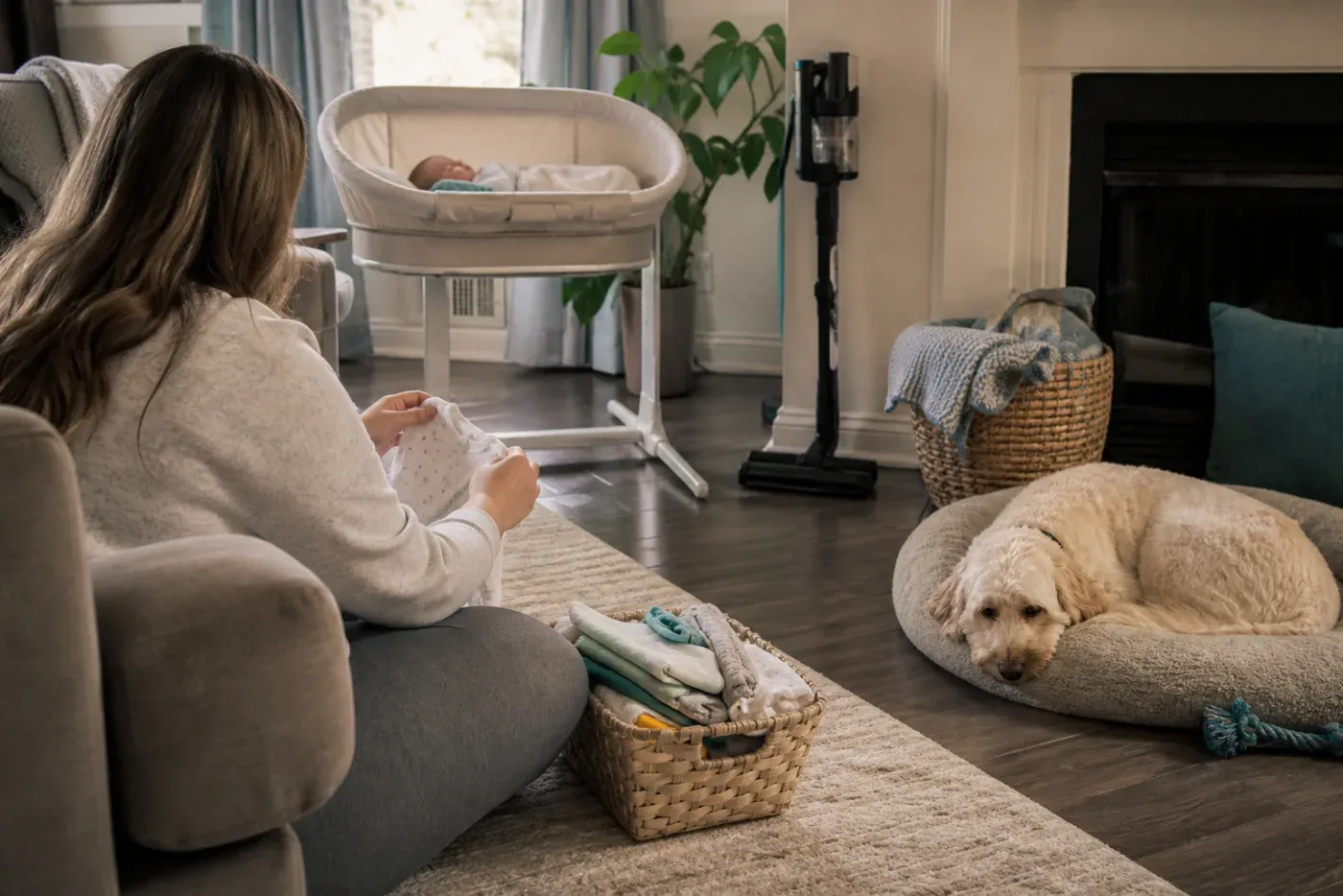
- The path between the sleep area, kitchen, and bathroom
- The main living-room rug or floor
- Areas where pet hair collects
- Visible crumbs, tracked soil, and spills
- Entryways used by visitors
Vacuum or clean floors as needed rather than following an inflexible daily schedule. Use products appropriate for the floor and keep the baby away until the surface is dry and the room is ready for use.
Living with pets and a newborn
Keep pet bowls, litter boxes, waste, toys, and cleaning supplies separate from baby feeding and changing areas. Wash hands after handling pet waste or cleaning pet areas.
Routine vacuuming and removal of visible pet hair may be more sustainable than repeatedly deep cleaning the entire home. Questions about a baby's allergies, immune system, or contact with a particular pet should go to the pediatrician.
Cleaning, Sanitizing, and Disinfecting: What's the Difference?
These three words are often used interchangeably, but they are different tasks. Cleaning removes dirt, crumbs, and germs from a surface with soap or detergent, water, and wiping. Sanitizing lowers germs to a level public-health standards consider safe. Disinfecting uses an EPA-registered product to kill most germs on a hard surface after it has been cleaned.
The CDC says regular cleaning is enough in most household situations. Disinfection may be appropriate when someone is sick, when a surface is contaminated, or when a healthcare professional recommends additional precautions for someone at higher risk.
| Task | What it does | When to use it | Newborn-home example |
|---|---|---|---|
| Clean | Removes dirt, crumbs, and germs with soap or detergent, water, and wiping | Everyday, on most surfaces | Wiping the changing table or kitchen counter |
| Sanitize | Lowers germs to a level considered safe by public-health standards | Feeding items—especially for babies under 2 months, premature, or immunocompromised | Sanitizing washed bottles and pump parts per CDC and manufacturer directions |
| Disinfect | Kills most germs on a hard surface with an EPA-registered product, after cleaning | Situational—illness, a contaminated surface, or a provider's advice | Treating a changing surface after contamination, following the label |
When a disinfectant is appropriate:
- Clean visible dirt first.
- Use a product suitable for the surface.
- Follow the label, including contact time and ventilation directions.
- Never mix cleaners or disinfectants.
- Keep children and pets away during use.
- Store products securely when finished.
Avoid spraying products near the baby. A stronger odor or a larger amount of product does not mean a better clean.
How to Choose Cleaning Products With a Newborn at Home
"Baby-safe" and "newborn-safe" are common marketing terms, but they are not a substitute for reading the label. Choose a product made for the surface and task, follow its directions, and use only the amount instructed. Never describe a product as chemical-free: water, soap, and every cleaning ingredient are chemicals.
For routine household cleaning, consider products carrying the EPA Safer Choice label. EPA reviews every intentionally added ingredient in a Safer Choice-certified formula against its human-health and environmental criteria. The label does not mean that a product can be used carelessly or that it is appropriate for every surface or every task.
Be skeptical of vague "green" or "natural" claims on the front of a bottle. The EPA's guidance on identifying greener cleaning products and the Safer Choice FAQ make the same point: "natural" does not automatically mean safer, an independent label is more reliable than marketing language, and you should still follow directions and never mix products. The American Academy of Pediatrics' green-cleaning guidance adds that simple options—soap and water with good ventilation—handle most everyday cleaning around a baby.
Use these practical rules:
- Prefer cleaning over disinfecting when routine cleaning is enough.
- Check whether a product is a cleaner, sanitizer, or disinfectant; those are different functions.
- Follow dilution, ventilation, protective-equipment, contact-time, and rinse instructions.
- Never mix cleaning or disinfecting products.
- Avoid spraying or using products in the same occupied space as the baby when the label calls for ventilation or restricted access.
- Let treated surfaces dry or complete any label-required rinse before use.
- Store every product closed, labeled, and out of reach of children and pets.
If the baby was born prematurely, has a weakened immune system, or has another individual health concern, ask the pediatrician whether the household needs additional precautions. A cleaning-product label and a professional cleaning company cannot replace individualized medical guidance.
Visitors: Focus on Simple Household Boundaries
Visitors can bring food, gifts, shoes, coats, and extra activity into the home. The house does not need a complete reset after every visit.
Useful boundaries may include:
- Asking visitors to wash their hands when they arrive
- Keeping shoes and bags in a defined entry area
- Cleaning high-touch surfaces as part of the regular routine
- Postponing visits when someone is ill
- Keeping feeding and diaper supplies in their designated spaces
Follow your pediatrician's guidance about visitors, illness exposure, vaccines, or contact with the baby. A cleaning company should not set medical visitation rules.
How to Prepare for a Professional Cleaner After Baby Arrives
A professional cleaning visit can reduce the workload when the household is short on sleep or when physically demanding tasks keep getting postponed.
Recovery after birth is real and individual. The American College of Obstetricians and Gynecologists describes the postpartum period as lasting roughly twelve weeks and beyond, with activity and lifting guided by your own clinician. Delegating physically demanding cleaning is one practical way to protect that recovery—follow your provider's advice about what you should and shouldn't do.
You do not need to organize the whole house before the cleaners arrive. Instead:
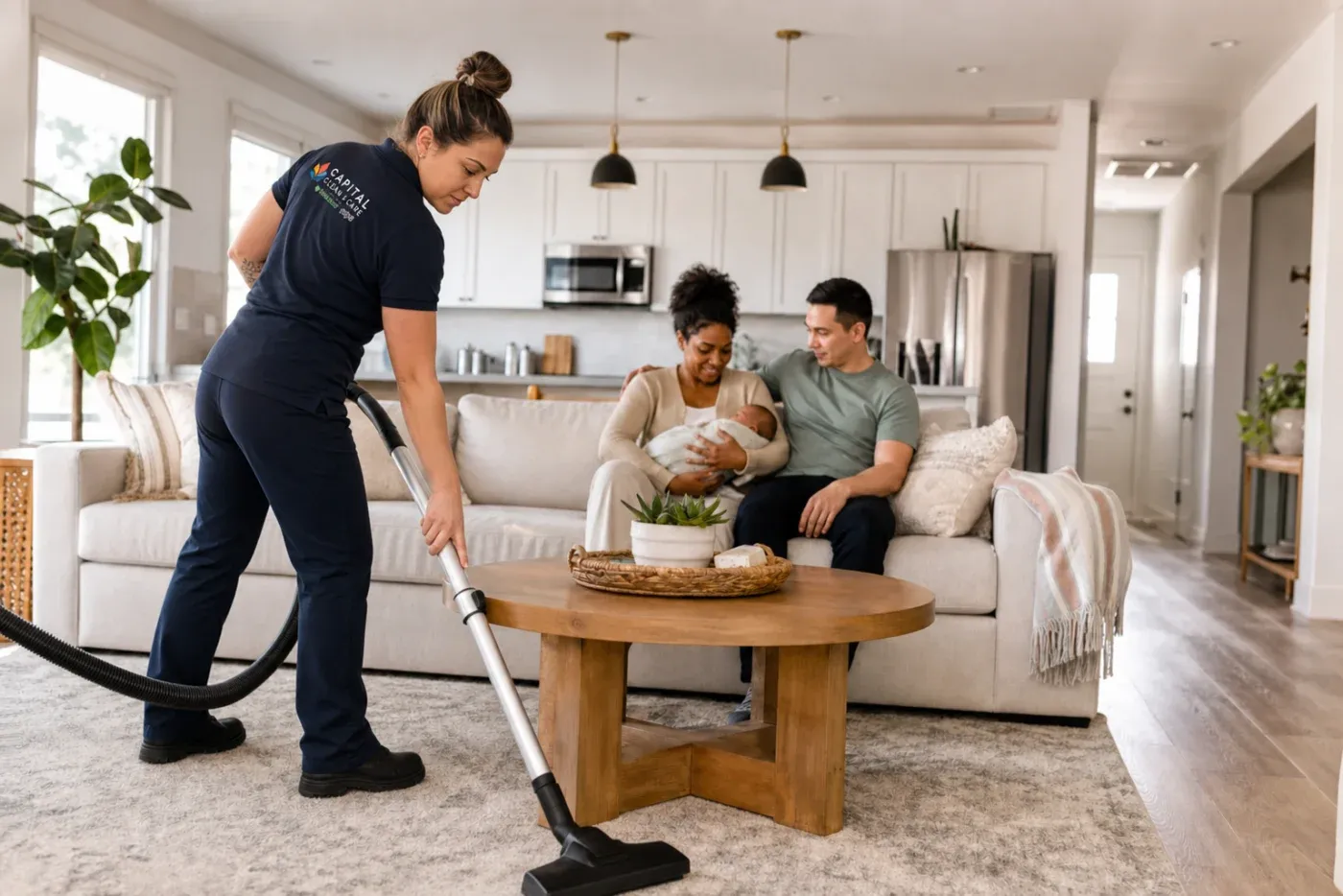
- Identify the two or three rooms that matter most.
- Secure medications, personal documents, valuables, and feeding supplies.
- Tell the company where the baby and pets will be during the visit.
- Share product preferences or surface restrictions in advance.
- Ask the team to avoid spraying products near occupied rooms.
- Keep feeding-item cleaning separate unless the service explicitly includes it and follows your instructions.
High-value priorities often include bathrooms, kitchen surfaces, floors, accumulated dust, and the primary living area. Personal baby-care tasks, bottle preparation, and medical equipment should remain with the family unless a qualified service has been specifically arranged.
Capital Clean Care offers house cleaning, deep cleaning, recurring cleaning, and eco-friendly cleaning across Maryland, Washington DC, and Northern Virginia.
Capital Clean Care
Professional help can be a lifesaver after baby arrives
Capital Clean Care handles bathrooms, kitchen, floors, and accumulated dust while your family focuses on rest and caring for the newborn. Serving Maryland, DC & Northern Virginia.
Weekly Newborn-Home Cleaning Checklist
Use this list as a flexible menu. It does not need to be completed in one day.
Every day or as needed
- Move used feeding items to their designated cleaning area
- Reset the changing area and remove visible soil
- Wipe visibly dirty kitchen or bathroom surfaces
- Gather essential laundry
- Remove diaper waste and trash when needed
- Clear safe walking paths
A few times each week
- Vacuum or clean the most-used floor areas
- Address visible pet hair
- Wash essential baby and adult laundry
- Clean the primary bathroom
- Wipe frequently touched handles and switches
Weekly or when manageable
- Change household linens according to your family's routine
- Clean less-used floors and surfaces
- Check supplies and restock essentials
- Clean hampers, bins, or baskets as needed
- Delegate postponed deep-cleaning tasks
Frequently Asked Questions
How do you keep your house clean with a newborn?
Does a house need to be disinfected every day for a newborn?
How often should you clean floors with a newborn?
How should baby bottles and feeding items be cleaned?
Is it okay to use a cleaning service with a newborn at home?
What should a cleaner focus on after a baby comes home?
What is the difference between sanitizing and disinfecting for a newborn?
Do I need to sterilize or deep clean the whole house before baby comes home?
A Routine That Supports the Family
A newborn-home cleaning routine should reduce friction, not create another standard the family cannot meet. Keep feeding and diaper workflows separate, clean visible soil, maintain the rooms you use most, and let optional projects wait.
Let Us Handle the Heavy Work
If bathrooms, floors, dust, and recurring household cleaning are taking time away from rest and family care, Capital Clean Care can help. Request a free quote for professional cleaning in Maryland, Washington DC, or Northern Virginia.

Rodrigo Reis
Founder & Owner, Capital Clean Care
Rodrigo founded Capital Clean Care in 2015 and still runs it as a family-owned, Latino-operated business. Over 10+ years his team has cleaned 500+ homes across Montgomery County and the wider DMV, and the pricing and checklists in these guides come from the real quotes and jobs they run every week, not national averages. Read our story →