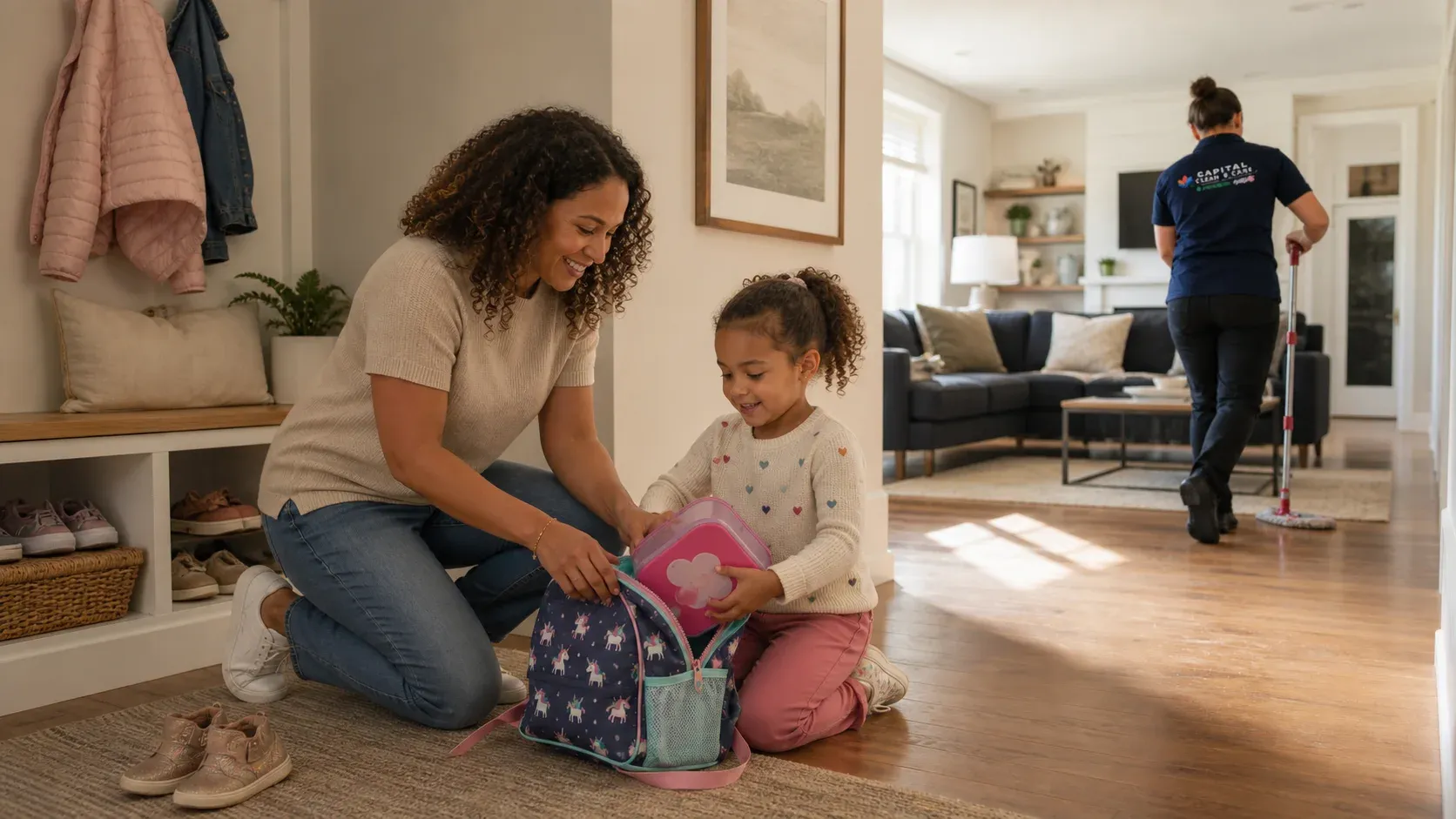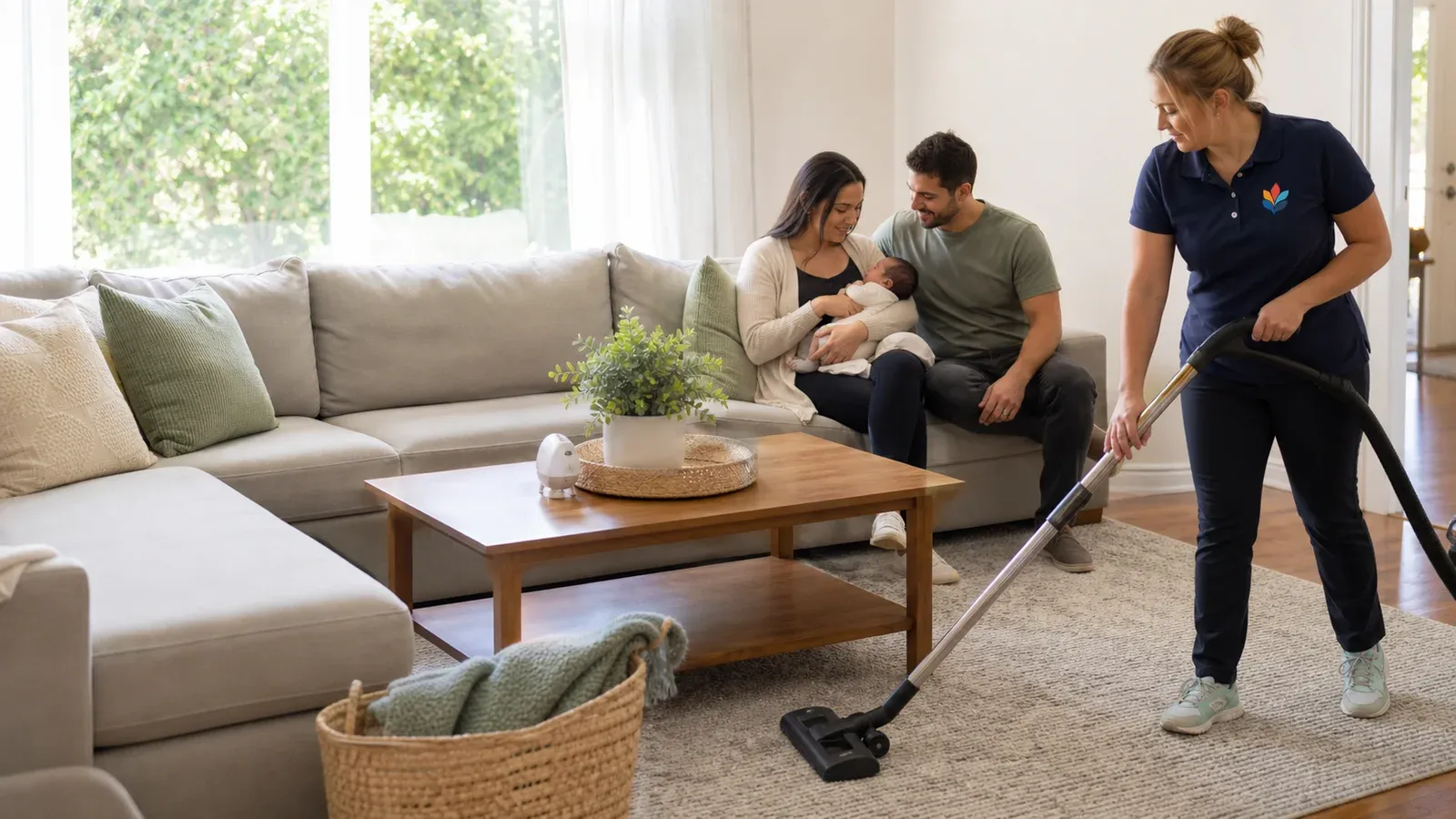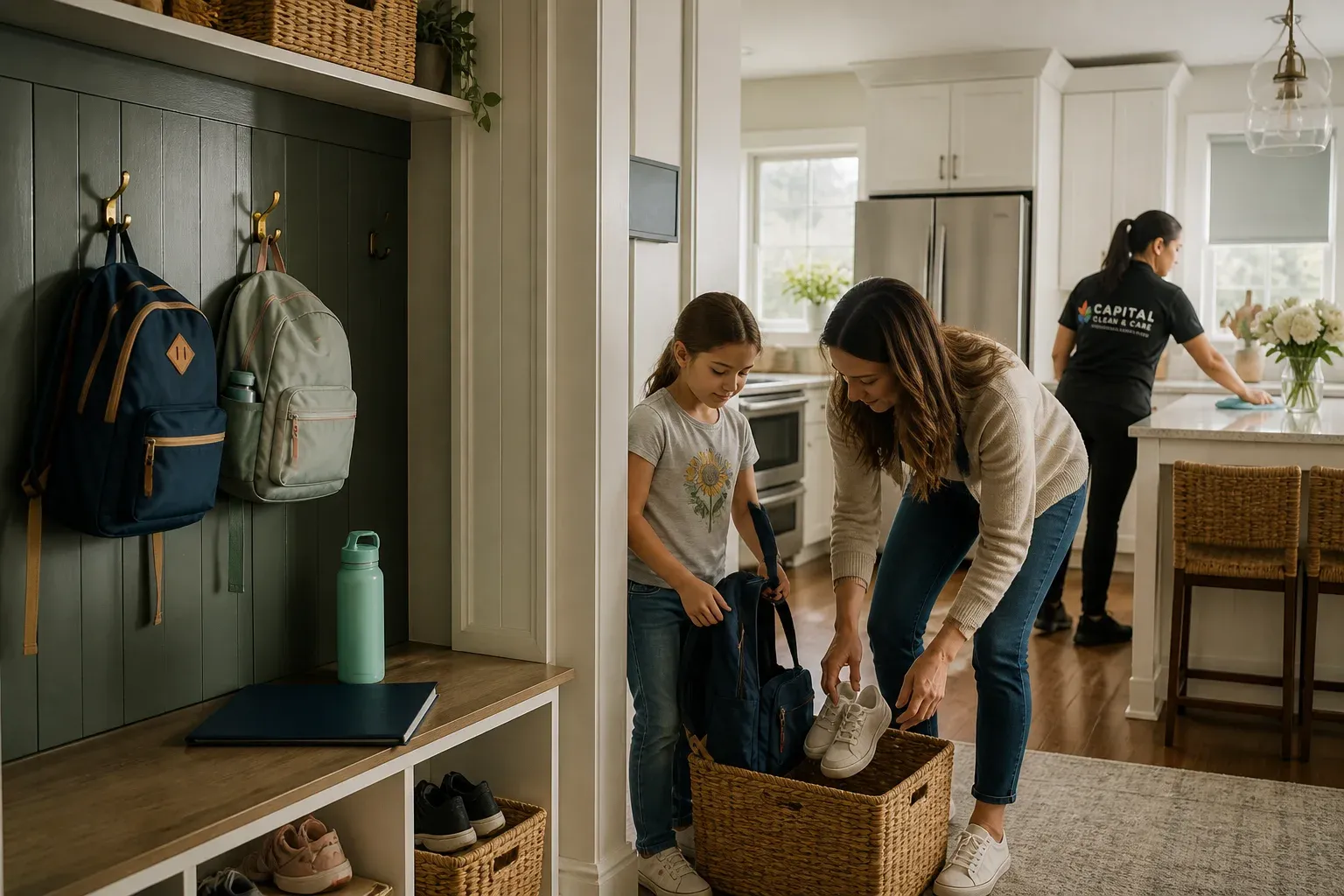
The best cleaning schedule for working parents with school-age kids uses three layers: a 10- to 15-minute family reset on ordinary days, a few rotating weekly maintenance tasks, and a separate plan for deeper work. Children help with one clearly taught, age-appropriate responsibility; adults keep control of cleaning products, safety decisions and quality-sensitive tasks.
The minimum viable clean
On a late practice, homework-heavy or low-energy night, do only this: refrigerate food, contain dishes, wipe active food-prep surfaces, address spills, clear walking paths, place dirty clothes in hampers and reset school items for morning. Everything else can move. A schedule that survives hard days is more useful than a perfect chart that fails by Wednesday.
What Changes When Children Reach School Age?
The preschool guide focuses on cleaning backpacks and lunch boxes. School age adds homework, sports, larger wardrobes, more independent food preparation and the ability to contribute meaningfully to household routines. The goal is no longer to clean around children; it is to build a home system they can gradually learn to participate in.
- A consistent landing zone for backpacks, shoes, papers, devices and water bottles.
- A short after-dinner reset that has a visible finish line.
- One child-owned task taught before additional responsibilities are added.
- Weekly maintenance spread across the week instead of saved for one exhausting weekend block.
- Professional recurring cleaning used for the baseline, not as a substitute for daily family organization.
The 15-Minute After-School and Evening Reset
| Moment | Family action | Done means |
|---|---|---|
| Arrival | Shoes, backpack, papers and bottle go to one landing zone | Walkways stay clear and school items are findable |
| Kitchen close | Food stored, dishes contained, counters wiped where used | No exposed food or active spill remains |
| Room reset | Belongings returned, dirty clothes in hamper, floor path clear | The room is functional—not inspection-ready |
| Morning setup | Bag, device, papers and activity gear staged | The next day starts without a search party |
Use a timer as a boundary, not a threat. When the reset ends, it ends. If one area repeatedly exceeds the time available, change the storage system or move that task to the weekly rotation instead of asking the family to move faster every night.
Capital Clean Care
Keep the family reset small
Capital Clean Care can maintain bathrooms, kitchen surfaces, floors, dust and common areas so family time is not consumed by the heaviest recurring work.
Age-Appropriate Cleaning Chores for Ages 5–12
The American Academy of Pediatrics advises introducing one task at a time, explaining expectations clearly and praising effort rather than demanding perfection. The examples below are starting points, not tests of development. Adjust for ability, maturity, supervision and the tools used.
Ages 5–7
Make the bed, put belongings away, place laundry in a hamper, dust, sort laundry, set or clear the table, sweep a small area.
Ages 8–10
Continue earlier tasks; vacuum, put away laundry and groceries, help prepare food and take on supervised pet care.
Ages 11–12
Continue earlier tasks; change sheets, unload the dishwasher, fold laundry and help clean a kitchen or bathroom with adult direction.
Read the full AAP age-appropriate chores guidance. Adults should store products out of reach, read labels and never ask children to mix cleaning products. “Helping clean the bathroom” can mean putting towels in a hamper or wiping a mirror with an adult-approved method—not automatically handling disinfectants.
A Weekly Cleaning Schedule That Protects the Weekend
| Day | Adult focus | School-age contribution |
|---|---|---|
| Monday | Kitchen surfaces and refrigerator check | Clear table; put lunch items away |
| Tuesday | Bathrooms | Collect towels; reset personal items |
| Wednesday | Laundry and linens | Sort or put away own clothes |
| Thursday | Vacuum or mop traffic zones | Clear floor and vacuum if age-ready |
| Friday | Paper, entryway and activity-gear reset | Empty backpack and return gear |
| Weekend | One priority or professional service | Maintain own space; enjoy the weekend |
This is a template, not a prescription. Families with pets, allergies, multiple children, frequent visitors or heavy floor traffic may need different frequencies. A biweekly recurring cleaning service can take the larger maintenance block; weekly service may fit homes with higher use or less available time.
Cleaning vs. Disinfecting After School
Routine cleaning is the default in most homes. CDC explains that cleaning removes dirt and many germs, while sanitizing and disinfecting are separate steps. Disinfecting is generally more relevant when someone is sick or at higher risk—not as an automatic whole-house ritual every afternoon.
- Clean visibly dirty and frequently touched surfaces with a product appropriate for that surface.
- If disinfection is needed, clean first and use an EPA-registered product exactly as labeled.
- Respect the product's contact time; a quick spray-and-wipe may not disinfect.
- Ventilate as directed, keep products away from children and pets, and never mix chemicals.
- Follow manufacturer instructions for phones, tablets, keyboards and other electronics.
See the current CDC home cleaning and disinfecting guidance and the EPA Safer Choice product directory. “Eco-friendly” does not mean label-free or risk-free; suitability, directions and safe storage still matter. Learn how our eco-friendly cleaning approach fits into professional service.
What to Delegate to a Professional Cleaner
The most useful dividing line is daily family ownership versus labor-intensive home maintenance. Family members still put away personal items, manage dishes and food, sort papers and prepare for school. A professional can maintain the baseline that consumes larger blocks of time.
- Bathrooms, including toilets, sinks, showers, tubs and exterior fixtures within the booked scope.
- Kitchen exterior surfaces, counters, sink and buildup addressed by the selected service.
- Vacuuming and mopping accessible floors after family clutter is moved.
- Dusting accessible furniture, ledges and common-area surfaces.
- Periodic deeper work agreed in advance, rather than silently adding it to a standard visit.
Compare our house cleaning services and recurring options. The right frequency depends on household size, floor traffic, pets, activities, priorities and budget—not a universal rule.
Frequently Asked Questions
What is the best cleaning schedule for working parents with school-age kids?
Use a short daily reset, one focused maintenance task on selected weekdays, and a separate recurring or monthly deep-cleaning plan. School bags, shoes, dishes, counters, laundry, and visible spills need prompt attention; bathrooms, floors, dusting, and linens can be distributed across the week. The best schedule is flexible enough to restart after a busy or sick day.
How long should a family clean each day?
There is no universal required number. For many families, a 10- to 15-minute shared reset is a practical starting point, not a health rule. Stop when the priority areas are functional: food is put away, dishes are contained, spills are addressed, walkways are clear, and school items are ready for tomorrow.
What chores can children ages 5 to 7 do?
The American Academy of Pediatrics lists examples such as making beds, setting and clearing the table, dusting, putting belongings away, placing dirty clothes in a hamper, emptying small wastebaskets, sweeping, and sorting laundry. Ability and supervision matter, so introduce one task at a time.
What chores can children ages 8 to 10 do?
AAP examples include earlier-age tasks plus vacuuming, helping prepare dinner or snacks, putting away laundry and groceries, and helping with pet care. Adults should teach the method, choose safe tools and products, and expect skills to improve with practice rather than demanding adult-level results.
What chores can children ages 11 to 12 do?
AAP examples include changing sheets, unloading the dishwasher, folding laundry, helping clean the kitchen or bathroom, and preparing a simple meal with supervision. Parents should still control chemical products and adjust tasks to the child's maturity and the home.
Should families disinfect the house every day after school?
Usually not. CDC says routine cleaning is enough in most homes; disinfecting is generally more relevant when someone is sick or at higher risk. Clean first, use a surface-compatible EPA-registered product when disinfection is actually needed, follow the label and contact time, and never mix products.
How do you keep a house clean with kids and a full-time job?
Reduce decisions: create a landing zone, assign ownership, keep daily resets short, rotate weekly tasks, and define a minimum viable clean for difficult days. Delegate recurring floors, bathrooms, kitchen buildup, and dusting when professional service fits the household budget.
Is recurring house cleaning useful for working parents?
It can be. A recurring service can maintain the labor-intensive baseline—bathrooms, kitchen surfaces, floors, dust and common areas—while the family manages daily belongings, dishes, food, laundry and school preparation. Scope and frequency should match the home, schedule and priorities.
A clean home should support family life—not replace it
Capital Clean Care provides professional house cleaning across Maryland, Washington, DC and Northern Virginia. Tell us what keeps falling through the cracks, and we will help you choose a realistic service scope and frequency.

Rodrigo Reis
Founder & Owner, Capital Clean Care
Rodrigo founded Capital Clean Care in 2015 and still runs it as a family-owned, Latino-operated business. Over 10+ years his team has cleaned 500+ homes across Montgomery County and the wider DMV, and the pricing and checklists in these guides come from the real quotes and jobs they run every week, not national averages. Read our story →
Rodrigo Reis
Founder & Owner, Capital Clean Care
Rodrigo founded Capital Clean Care in 2015 and still runs it as a family-owned, Latino-operated business. Over 10+ years his team has cleaned 500+ homes across Montgomery County and the wider DMV, and the pricing and checklists in these guides come from the real quotes and jobs they run every week, not national averages. Read our story →
See the Results: Real Before & After Videos
Every clip is unedited footage from our own DMV team, using the same eco-friendly products we bring to every home. This is the standard behind everything we write.
Authentic footage from our own team. No stock, no filters.
Get results like these